





A laminate flooring renovation can look simple on paper, but real homes rarely behave like display spaces. This project involved a two-storey townhouse with tight hallways, stairs, and all the constraints that expose poor planning quickly. Instead of chasing trends, the focus was on choosing a laminate floor that would withstand daily life, movement upstairs, and long-term wear. The decisions made here weren’t about shortcuts or surface looks, but about prep, join integrity, and matching the product to the house.
That context matters, as flooring choices that look brilliant in big open rooms can feel wrong in smaller, segmented layouts. This renovation wasn’t about chasing trends; it was about choosing something that would work every day for a young family.
Why We Chose Laminate
Hybrid was considered early. For so many homes, hybrids still make sense, but understanding the laminate and hybrid flooring differences helps avoid choosing the wrong tool for the job. Once they’d seen laminate in a lived-in home, furniture down, normal lighting, and kids moving around, the decision became easier.
Laminate still reads more naturally in many homes, especially when you’re choosing from a well-built laminate flooring range designed for long-term use. Hybrid wear layers (particularly cheap options) can reflect light, exaggerating sheen and ridging, especially upstairs, where light angles change throughout the day. Laminate transfers colour through the decorative layer differently, and in this case, it just looked right.
Board Length: The Quiet Decision That Changes Everything
Here’s a detail people underestimate: plank length.
The boards chosen were around 1.38 metres long. For years, I’d overlooked that length because in larger homes, I prefer longer planks; they suit wide rooms and long sightlines. In a townhouse like this, shorter boards actually worked better.
Long planks in tight spaces can visually overpower rooms and make hallways feel chopped up. Shorter boards break up runs naturally and calm the layout down. Same product category, completely different outcome depending on scale.
If the budget had been tighter, I would’ve stayed in the same laminate family and dropped thickness or range, not the category. The logic stays the same: match the product to the space, not the other way around.
Upstairs Installs Are Less Forgiving
Upstairs floors behave differently from ground floors. There’s more movement over time, more flex, and less tolerance for shortcuts. That’s where floating floors either prove themselves or start showing weaknesses.
This install was approached with that in mind. The goal wasn’t just to make it look good on day one, but to make sure it still felt solid years later.
The Subfloor Reality (Where This Job Was Won or Lost)
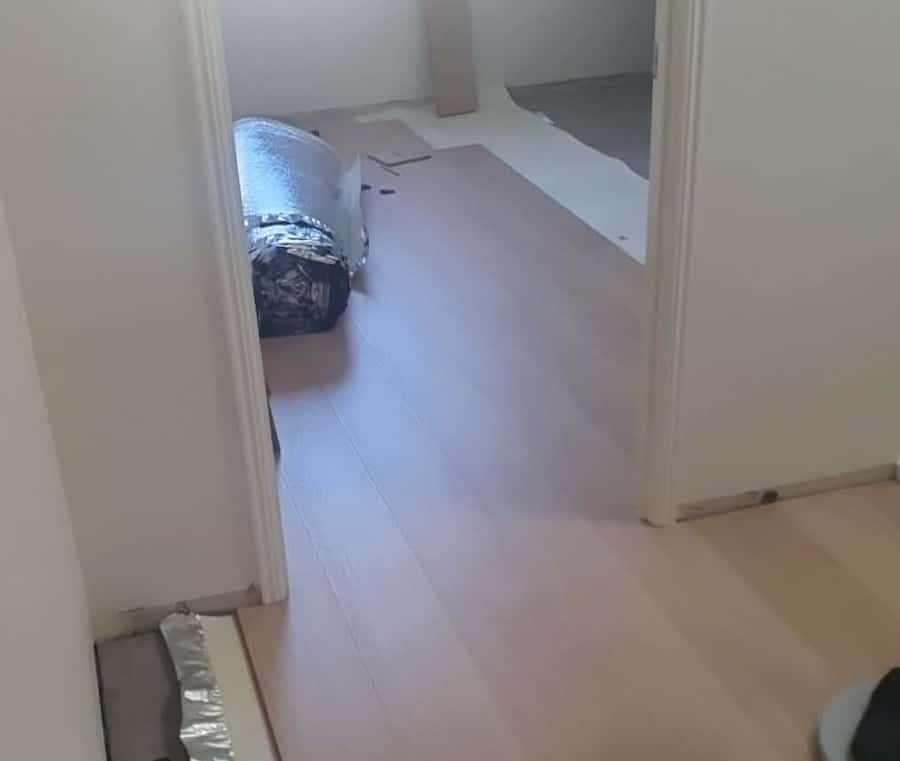
The subfloor was rough, with up to 21mm variance in places. That’s massive for a floating floor.
Instead of flooding everything with levelling compound, the prep was done properly:
- FC sheeting was used to bolt out the major highs and lows
- The levelling compound was used only where needed
The result was genuinely flat, what I’d call billiard-table flat. That’s not overkill; that’s the necessary floor levelling for floating floors needed if you want joins to last and noise to stay down.
Most failures people blame on a bad product actually start with poor subfloor preparation for laminate flooring. People spend big on flooring, then rush the prep. Six months later, joins start clicking, boards move, and everyone blames the product.
Installation Order Working With the House
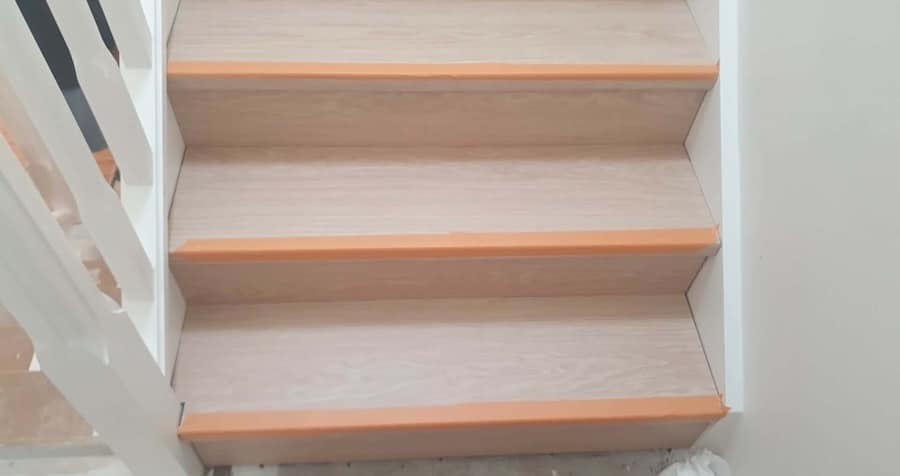
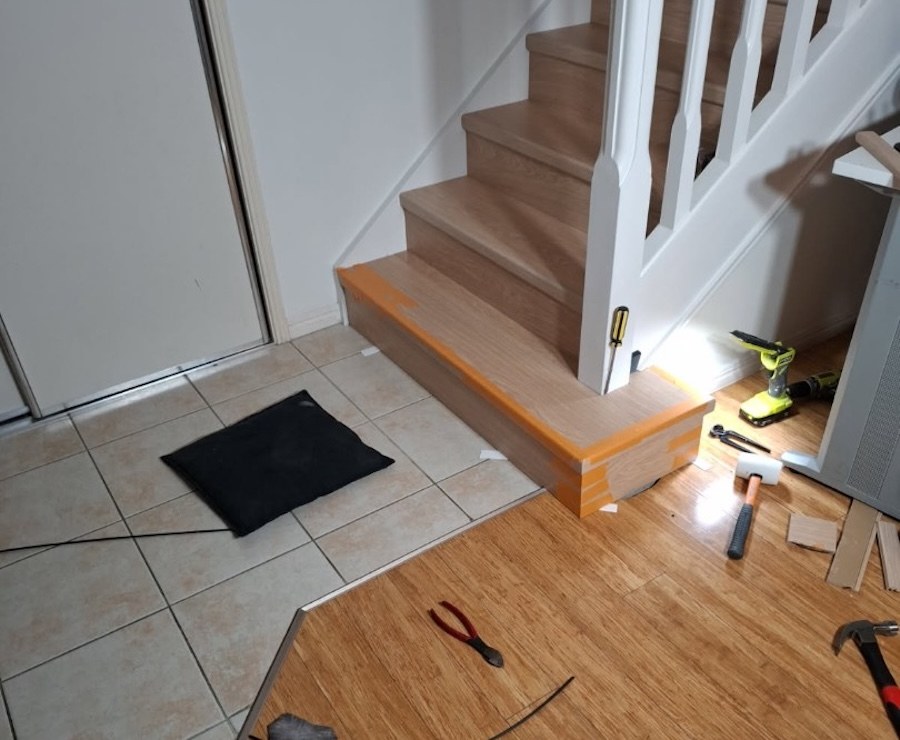
Installation started at the top of the stairs and worked down, rather than the usual bottom-up approach. That allowed progress without boxing the job in and made stair alignment cleaner.
Upstairs was tight. Door jambs, narrow hallways, and awkward transitions meant there was nowhere to hide sloppy cuts. A couple of boards were sacrificed in tricky areas, totally normal. Anyone who tells you there’s no wastage hasn’t laid floors in real houses.
Locking Systems Where Stress Levels Are Set
This is where experience matters. Not all click systems behave the same, especially with rigid 12mm boards. Being able to lay boards flat and pull them together flat made a massive difference under door jambs and in confined spaces.
There were no forced joins, no shaving edges, and no glue as a panic fix. Once the boards were secured with our flooring locking systems, they felt very, very solid underfoot, the kind of solid you notice immediately when you walk across them.
Living With the Floor Noise and Feel
This part surprised me. Even with a standard underlay, the floor is noticeably quiet. In one of our articles entitled “What Floor Coverings Are Best at Reducing and Cancelling Noise?“, we mentioned that laminates commonly create the most air-borne noise amongst flooring materials. In this situation, the laminates felt quieter than the ones in my own home, which I now judge a bit harshly by comparison. No hollow sound, no drumminess, just a solid, settled feel.
Underfoot, the rigidity of the boards shows. Once joined, they don’t feel spongy or loose. Furniture went in, kids started using the space, and the floor did what it was supposed to do.
Durability in the Real World
This family has a four-year-old and a teenager living in this house. The floor cops traffic, toys, movement, and noise. That’s the test. Based on what I’ve seen, including laminate in my own home that’s over ten years old, there’s no reason this floor won’t still look good decades down the road. No visible passage wear, no scratching, no denting. Laminate, when it’s done right, ages quietly. The best flooring jobs are the ones you don’t worry about.
Subfloor, Joins & Why Floors Fail
If there’s one place renovations quietly go wrong, it’s under the floor. Most failures actually start with prep, movement, and joins being asked to do work they were never designed to do.
Why Subfloor Flatness Isn’t Optional
Floating floors don’t forgive. They rely on gravity and join integrity to stay put. When a subfloor is out, even by a few millimetres, boards flex, joins work harder, and noise creeps in. Many of the common laminate flooring problems people complain about trace back to joins being expected to compensate for uneven subfloors.
In this job, we measured up to 21mm variance. That’s not cosmetic; that’s structural in flooring terms. The fix wasn’t to pour buckets of leveller and hope for the best. It was to:
- Bolt out the big highs and lows with FC sheeting
- Use levelling compound sparingly, only where needed
The result was flat, stable, and predictable. That predictability is what keeps joins tight and floors quiet years later.
Floating Floors and Movement (Especially Upstairs)
Upstairs floors move more. Timber frames settle, spans flex, and load changes over time. A floating floor has to tolerate that movement without the joins giving up. This is where join quality matters more than thickness. A thick board with a weak join will fail sooner than a thinner board with a strong, well-engineered locking system. Over time, you’ll see it as:
- edge lift
- micro-gaps
- clicking or creaking underfoot
People often blame “expansion” or “humidity,” but the real issue is that the join has been asked to bridge movement it can’t handle.
Why Joins Tell the Truth First
Surface wear is slow. Joins fail early. When a floor starts to go, it rarely announces itself with scratches or fading. It starts with:
- boards popping at short ends
- gaps opening in high-traffic areas
- edges losing their crispness
Once that happens, you’re stuck. You can’t sand laminate. You can’t spot-fix joins. You live with it, or you rip it out. That’s the living hell homeowners talk about when they redo something they were proud of earlier on.
Cheap Floors Fail Differently
There’s a difference between a floor wearing and a floor breaking down. Cheaper products often look fine early, then:
- joins soften
- profiles round off
- tolerances open up
That’s when upstairs installs expose low-quality products. Slight sag over time becomes visible movement. The floor hasn’t “expanded,” it’s lost its ability to hold itself together. Using high-quality products for laminate flooring renovation projects saves you so much more in the long run.
But just to be clear, not all affordable flooring options are inadequate. There are viable options for flooring that can provide substantial value at lower costs. Discover our picks and tips for making the most of these budget-friendly options: Affordable Flooring Ideas: The Best Cheap Options for Your Budget.
Noise Is a Symptom, Not the Problem
Noise isn’t just annoying; it’s diagnostic. A drummy sound, clicking, or hollow feel usually means:
- The subfloor isn’t flat enough
- The underlay is compensating instead of supporting
- The joins are working too hard
Fixing noise after installation is almost impossible without lifting the floor. Preventing it is straightforward: flat subfloor, correct underlay, strong joins.
Why This Laminate Flooring Renovation Held Together
- Subfloor prep was taken seriously
- The join system was strong enough for a rigid board
- Upstairs movement was accounted for, not ignored
That combination is what lets a floating floor do what it’s supposed to do, sit there quietly and get on with life.
Value, Warranties & Why Cheap Floors Cost More
This is where I stop sugar-coating it, because this is the part that causes the most regret. People fixate on price, not value, and flooring is one of the fastest ways to learn the difference the hard way.
The $15 vs $65 Question
If you’ve got one laminate at $15 a square metre and another at $65, you have to ask what’s actually in that product. Think about the chain:
- manufacturer margin
- freight from overseas
- wholesaler margin
- retailer margin
By the time everyone’s taken their slice, what’s left inside a $15 product? If the answer is “not much,” that’s your answer. This isn’t about trying to talk people into spending more money for the sake of it. It’s about understanding that materials, tolerances, and join systems cost money, and they’re the bits that determine whether a floor lasts or falls apart.
What Warranties Really Mean
Warranties are one of the most misunderstood parts of flooring, even in laminate flooring renovation projects. A 10-year warranty does not mean:
“If anything goes wrong in 10 years, I get a new floor.”
Most flooring warranties are diminishing warranties. By year nine, you might be entitled to 10% of the product value, and that’s usually materials only. No labour. No disruption costs. No compensation for ripping out furniture or living through it again.
Meanwhile, the floor can start showing signs of deterioration years earlier:
- joins softening
- edges rounding
- visible gaps in walkways
That deterioration often isn’t classified as a “failure,” so the warranty never even kicks in.
Longer Warranties Usually Mean Better Ageing
- better surface design
- stronger joins
- tighter manufacturing tolerances
They don’t just last longer; they age better. There’s a big difference.
The Real Cost Is Redoing It
Here’s the part no one budgets for. Redoing floors after you’ve just renovated is a living hell. You’ve already spent the money. You’ve mentally moved on to the next project. Then two years later you’re:
- pulling furniture back out
- living through dust and noise again
- explaining to your partner why the “cheap win” wasn’t a win
You don’t just pay for the floor twice; you pay for it with your time and effort.
The Simple Rule I Live By
Spend as much as you can reasonably afford on your flooring. That doesn’t mean overpaying. You still shop around. You still get a sharp price. But once you’ve decided on a product, don’t undercut yourself by dropping quality just to shave a few dollars.
A good floor should disappear into your life. You shouldn’t be worrying about joins breaking down, boards popping out, or corridors fading. Do it once. Do it properly.
Who Is Laminate Flooring For?
By this point, the pattern should be clear: good flooring decisions aren’t about chasing trends, they’re about matching the product to the home and the people living in it.
Who Does This Type of Laminate Flooring Renovation Suit
- A family home with kids and real daily traffic
- Are renovating upstairs, where movement and noise matter more
- Want a floor that looks good now and in 20 years
- Don’t want to revisit the decision every time something creaks
It’s especially well-suited to:
- Two-storey homes
- Hallways and bedrooms
- Stair-connected layouts where consistency matters
When it’s installed properly, laminate does exactly what you want it to do: it stays out of the way.
Who It Might Not Be For
Laminate isn’t a silver bullet.
- Fitting out large commercial spaces that need full adhesion
- Chasing absolute realism above all else, with no kids and light use
- Expecting a cheap product to behave like a premium one
Then other options may suit you better. Vinyl plank still makes sense in many commercial environments. Timber can be great in the right home, with the right expectations.
The Big Takeaway
If there’s one thing years in this industry can teach you, it’s that most flooring regret doesn’t come from the colour choice, it comes from trying to save money in the wrong places.
People rarely regret buying a good floor. They regret buying one they have to worry about every day. Do the prep properly. Choose a product that suits the space. Spend what you can afford, not what sounds cheap.
Floors are meant to be lived on.